About me

Artificial Intelligence
Preference elicitation
Multi-objective combinatorial optimization
Methaheuristic
Algorithmic decision theory
Matroid
Articles
International conferences with proceedings
AAAI 2021
N. Benabbou, C. Leroy, Th. Lust, P. Perny : “Combining Preference Elicitation with Local Search and Greedy Search for Matroid Optimization”, Proceedings of the 35th AAAI Conference on Artificial Intelligence (AAAI'21), Virtual, France (2021)
ECAI 2020
N. Benabbou, C. Leroy, Th. Lust : “Regret-Based Elicitation for Solving Multi-Objective Knapsack Problems with Rank-Dependent Aggregators”, The 24th European Conference on Artificial Intelligence (ECAI'20), Saint Jacques de Compostelle, Spain (2020)
AAAI 2020
N. Benabbou, C. Leroy, Th. Lust : “An Interactive Regret-Based Genetic Algorithm for Solving Multi-Objective Combinatorial Optimization Problems”, Proceedings of the 34th AAAI Conference on Artificial Intelligence (AAAI'20), New York, United States (2020)
ADT 2019
N. Benabbou, C. Leroy, Th. Lust, P. Perny : “Combining Local Search and Elicitation for Multi-Objective Combinatorial Optimization”, 6th International Conference on Algorithmic Decision Theory (ADT'19), Durham, NC, United States (2019)
Conferences
ROADEF 2020
N. Benabbou, C. Leroy, Th. Lust : “Incremental Elicitation combined with Heuristic Research for Multi-Objective Combinatorial Optimization”, 21e congrès annuel de la société française de recherche opérationnelle et d'aide à la décision (ROADEF'20), Monptellier, France (2020)
MOPGP 2019
N. Benabbou, C. Leroy, T.Lust : "An Incremental Genetic Approachfor Multi-Objective Combinatorial Optimization with Imprecise Preferences" , 13th International Conference on Multiple Objective and Goal Programming (MOPGP'19), Marrakech, Morocco (2019)
Thesis
We are currently working on preference elicitation problems on combinatorial domains. We are at the intersection between algorithmic decision theory and artificial intelligence. In algorithmic decision theory, we are interested in the formal modeling of preferences and the efficient resolution of decision problems. We use heuristic procedures and learning from artificial intelligence to recommend a solution.
In particular, we are interested in problems where solutions are represented by n-dimensional vectors. All solutions are represented by this performance vector.
To determine the value of a multi-criteria solution there is a rich literature that proposes different aggregators depending on the type of behavior that we want to translate. Indeed, if we want to express equality, we will use OWA with descreasing weights, but it's a comprise we will use weighted sum. The common point between all these models is that they are parameterizable and this parameter allows us to adapt the model to the decision-maker's preferences.
The classical approach in elicitation is to learn, through a history and therefore a database, the best possible parameters. We wanted to learn the parameter in order to solve the problem afterwards. However, there were two problems: a high sensitivity of the parameters and parameters that were difficult to determine precisely.
The recent approach we use here is that we do not want to learn the parameters exactly. Instead of looking for the weight set that exactly represents the decision maker's preferences, we will try to reduce the space of the weight sets sufficiently until we find the best solution for the decision maker. To make decisions with partial preference information, we use a méthod based on minimax regret criterion.
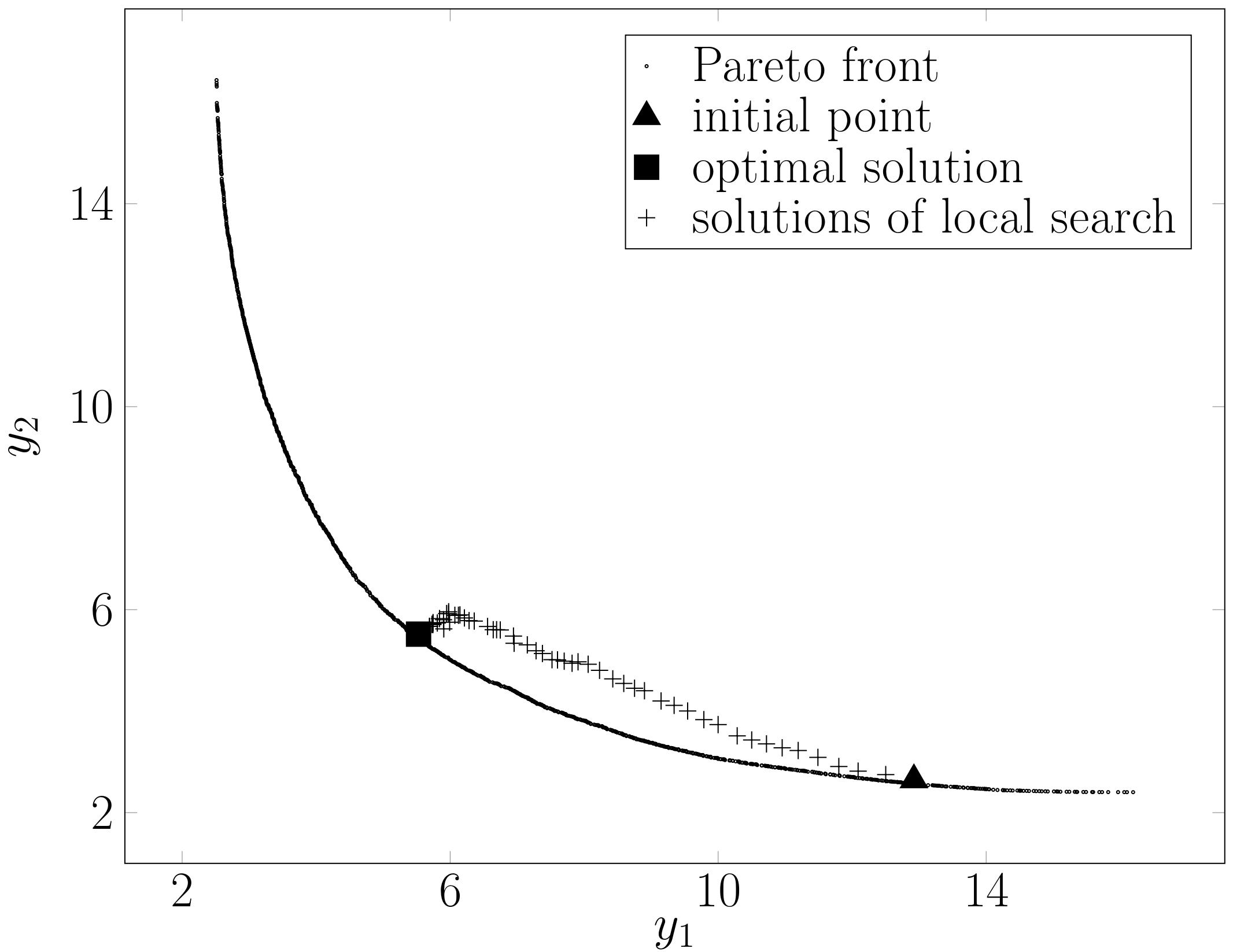
All the solutions are defined implicitly, because we are on combinatorial domain, we cannot enumerate them all but we know the conditions to define a solution. They are also too numerous to compare them all. The purpose of this thesis is to combine heuristic research and active learning to determine the decision maker's preferences. This allows us to attack difficult combinatorial problems that do not necessarily have an efficient algorithm for solving them. For example, in the figure above we can see a resolution of travelling salesman problem for 100 cities and 2 criteria. The decision maker is modeled by a weighted sum. We can see how the heuristic, in this case a local search, allows to approach, or return, the optimal solution of the decision maker.
Teaching
Introduction to object programming in Java
Undergraduate level 2
Sorbonne Université
2021/2020
2020/2019
Models for continous optimization and applications
Undergraduate level 2
Sorbonne Université
2021/2020
2020/2019
Type and data structure in C
Undergraduate level 2
Sorbonne Université
2020/2019